Instrumental analysis in laboratory
2019/9/28
So what is chromatography?
Chromatographic analysis, also known as chromatography, is a high-performance physical separation technology. If it is used in analytical chemistry and combined with appropriate detection methods, it is called chromatographic analysis. Chromatography was first used to separate plant pigments. Calcium carbonate was put into a glass tube and petroleum ether containing plant pigment (extract from plant leaves) was poured into the tube. At this time, the mixed bands of several colors appear immediately at the upper end of the glass tube. Then rinse with pure petroleum ether. With the addition of petroleum ether, the band moves downward continuously and gradually separates into several different color bands. If you continue to rinse, you can receive various colors of pigments and identify them respectively.
The present chromatographic method is not limited to the separation of pigments, and its method has been greatly developed, but its separation principle is still the same, still known as chromatographic analysis.
Interpretation of the basic principles of chromatographic separation:
In chromatography, there are two phases. One is stationary, which is called stationary phase, and the other is continuously flowing through the stationary phase, which is called mobile phase.
The principle of chromatography is to use the difference of partition coefficient and adsorption capacity of various substances to be separated in two phases. The mobile phase (gas, liquid) containing the sample is forced to pass through a stationary phase surface which is fixed in a column or on a flat plate and is immiscible with the flow. When the mixture carried in the mobile phase flows through the stationary phase, the components in the mixture interact with the stationary phase. Due to the differences in the properties and structures of the components in the mixture, the magnitude and strength of the force generated between the stationary phases are different. With the movement of the mobile phase, the mixture is distributed and balanced repeatedly between the two phases, making the retention time of each component in the stationary phase different, so that the components flow out successively from the stationary phase in a certain order. Combined with appropriate detection methods, the separation and detection of each component in the mixture can be realized.
Chromatographic analysis has many advantages: good separation effect, simple equipment, convenient operation, mild conditions, various methods, can adapt to different needs. The main disadvantages are: small processing capacity, long cycle, unable to operate continuously; some chromatographic media are expensive, sometimes can not find a suitable medium.
There are various types of chromatographic analysis (chromatography)
According to the two-phase state, it can be divided into:
According to the state of stationary phase, it can be divided into:
Column chromatography: the stationary phase was packed in the column;
Paper chromatography: filter paper is used as carrier and water adsorbed on paper is used as stationary phase;
Thin layer chromatography: a thin layer of solid adsorbent is made on glass plate or plastic plate as stationary phase.
According to the separation principle, it can be divided into:
Partition chromatography: using the difference of partition coefficient of different components between the two groups for separation;
Adsorption chromatography: using the surface of adsorbent (usually solid phase) to separate different components;
Ion exchange chromatography: a method of separation based on the exchange capacity of different ions in solution and ion exchanger;
Steric exclusion chromatography: separation of molecules of different sizes using porous materials.
Practical application of chromatographic analysis
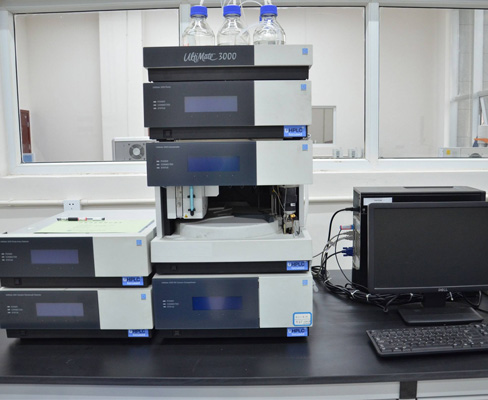
Chromatographic analysis is one of the most active research and application fields in the field of instrumental analysis. As chromatographic analysis can continuously concentrate, separate, purify and determine the sample, it has become the analysis and detection means commonly used by every analyst. It has been widely used in petroleum, chemical, food, medicine, health, metallurgy, geology, agriculture, environmental protection and other industries. It can be said that chromatographic analysis is used wherever there is an analytical task 。 The development of gas chromatography-mass spectrometry (GC-MS), ion chromatography (IC), supercritical fluid chromatography (SFC), capillary zone electrophoresis (CZE) and other technologies in the past 20 to 30 years have made the field of chromatographic analysis full of vitality. In particular, capillary electrophoresis has the advantages of high separation efficiency (column efficiency of more than 1 million theoretical plates / M), small sample consumption (10-6-10-9 ml), high sensitivity (detection limit as low as 10-15-10-20 mol · L-1) and fast separation speed (less than 10-10) It is suitable for the analysis of ionic macromolecules, such as amino acids, nucleic acids, peptides and proteins, and even the rapid and efficient determination of cells and viruses. It has a very broad application prospect in the field of biological analysis and life science.
In agriculture, gas chromatography can be used to determine pesticide residues, amino acids, vitamins, hormones, sugars, lipids, nucleic acids and so on. It can also be used to analyze some metal ions and CO2, SO2, H2S, methane in the atmosphere. High performance liquid chromatography (HPLC) can be used for the analysis of vitamins, alkaloids, hormones, amino acids, pesticides, nucleic acids, coumarins, lipids and other organic substances, as well as some inorganic ions and metal elements. Ion chromatography is a liquid chromatography technique for the analysis of inorganic and organic ions. It can determine hundreds of anions, cations and compounds. It is most suitable for the simultaneous analysis of multi-component and multi-element. The method has the advantages of good selectivity, less sample consumption, high sensitivity and easy automation. It is the best method for the analysis of anions in water, and is widely used in the determination of environmental water samples.
If you want to know more about chemical analysis, please click to check the related information of Ribao http://hflbaophychem.com

Hefei Lbao Physical & Chemical Science Co.,Ltd all rights reserved {Disclaimer} Anhui ICP No. 12,002,368